

 GMA Brandtalk
 Tracking
 Archives

Subic LGU starts cleanup of dumpsite in Aeta ancestral land; claims it was not inhabited
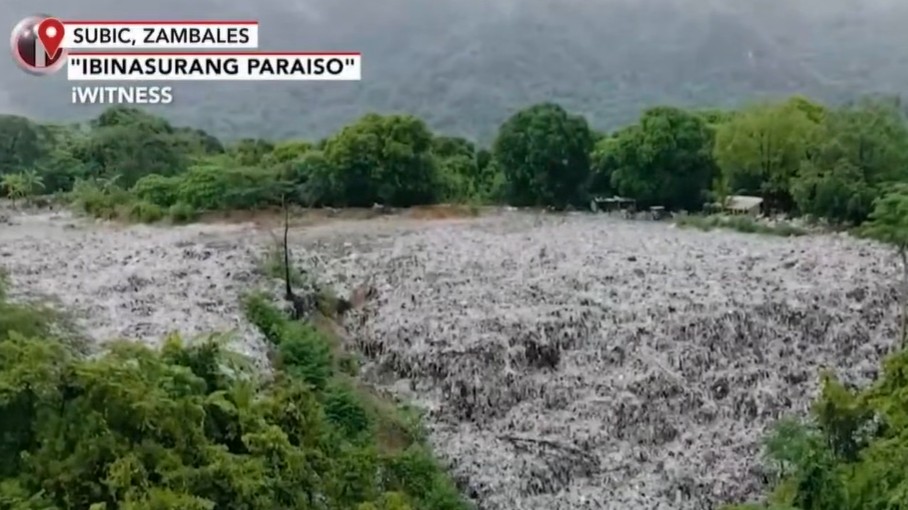
The municipality of Subic reportedly started its cleanup operations on the portion of an ancestral domain owned by an Aeta community in Zambales that was turned into a dumpsite.
According to Tina Panganiban-Perez’s report in “24 Oras” on Tuesday, the cleanup began after Aetas lamented their situation in a recent documentary by “i-Witness.”
They find it ironic especially looking back at how they were treated in the lowlands.
“Kapag nagtitinda nga po kami ma'am, sabihin nila kaagad-agad na, 'Wawalisan ninyo, lilinisan niyo yung kwan, yung pwesto ninyo’. Kaagad-agad sabihin po nila yun, sumusunod naman po kami ma'am. Pero sila po bingi lang po sila o ano po sila,” said Erlinda Capistrano.
(Whenever we sell our goods, ma'am, they immediately tell us, 'You should sweep, clean your spot.' They demand it right away, and we always obey, ma'am. But when it comes to them, they seem to turn a deaf ear, or I don't even know what.)
Due to the increasing amount of garbage, what was once a green landscape now bears a scar composed of trash, permeating the once fresh air with the stench of decomposing waste.
Residents are also facing a water shortage, as local water sources have been contaminated by the garbage and its toxic leachate.
This directly contradicts the explanations given to them by the local government before the dumping operations started in 2019.
“‘Yun nga po ang sabi nga po, papagandahin dun,” said Marites Gonzales.
(That’s what we were told—that they were going to make the area better.)
Much of the garbage consists of medical waste dating back to the global pandemic, the report said.
The open dumpsite was first discovered by the Department of Environment and Natural Resources (DENR) in January 2022, operating in violation of the Ecological Solid Waste Management Act.
While dumping operations were suspended in October 2025 and the facility was formally closed this past March due to protests from local indigenous groups, the accumulated waste has yet to be fully cleared up.
“During that time po, ang gusto lang namin maitapon ang mga napakadaming basura. Immediate solution lang ito, hindi ito magtatagal,” said Subic municipal engineer Marian del Castillo.
(At that time, our only goal was to dispose of the massive volume of garbage. This was meant to be a temporary, immediate solution—not a long-term one.)
“Isolated po yung area eh, wala pong nakatira doon. Gubat po yung area kaya pansamantala po doon namin naisip ilagay,” she added.
(The area is isolated; no one lives there. It's a forested area, which is why we decided to temporarily place it there.)
But indigenous residents live in the area, which was designated their ancestral domain.
According to the community’s leader, the local government of Subic had them sign an agreement regarding the land.
“Ang sabi nila sa amin, buwan-buwan, magbibigay sila sa amin ng P10,000 assumption,” said former chieftain Virgilio de los Santos.
(We were told that they would give us P10,000 monthly.)
“Kahit na hindi kami papayag… pagpatuloy nila, kasi naumpisahan na nila. Kaya kami nag-react, nalaman na namin na napatag na nila,” he added.
(Even if we disagreed... they would have pushed through anyway because they had already started. That's when we reacted, when we realized they had already leveled the land.)
But the local government denied the Aeta’s allegations, claiming that they were not aware that there was an indigenous community living nearby the dumpsite.
“Hindi naman alam na may community doon sa area,” said Subic MENRO OIC Mary Grace Molina.
(We were not aware that there was a community living in that area.)
Following the airing of the documentary, the National Commission on Indigenous Peoples (NCIP) reportedly reached out to the indigenous community, according to information obtained by the production team.
Garbage collection efforts have also reportedly begun. This was confirmed by the DENR Environmental Management Bureau (EMB) Region 3, which stated that the waste will be transferred to an authorized sanitary landfill.
“The LGU has already begun transportation its residual solid waste to a duly authorized sanitary landfill facility to ensure its proper and environmentally sound disposal while the closure and rehabilitation of the subject area is underway,” said DENR-EMB Region 3.
The department added that it has already coordinated with the provincial government and conducted an inspection and compliance monitoring at the site.
“The DENR, through the Environmental Management Bureau (EMB) Region III and in coordination with the Provincial Environment and Natural Resources Office (PENRO)-Zambales, had already undertaken a series of inspections and compliance monitoring activities at the site,” said DENR-EMB Region 3.
A safe closure and rehabilitation plan has also been approved by the local government of Subic, the DENR-EMB Region 3 added.
The Aeta community hopes this initiative leads to the genuine rehabilitation of their ancestral land upon which they solely rely—a territory that serves not only as their home and source of sustenance, but as a priceless inheritance to be preserved for future generations.
“Naaawa din po ako sa lugar na bakit ginanaito po nila. Masakit po sa damdamin po, ma'am. Napakasakit po,” said Erlinda.
(It breaks my heart to see what they did to this place. It hurts deeply, ma'am. It hurts so much.) —Vince Angelo Ferreras/RF, GMA News

