

 GMA Brandtalk
 Tracking
 Archives

SONA 2026: Climate groups flag absence of key issues like El Niño, active transport; react to nuclear power, energy concerns
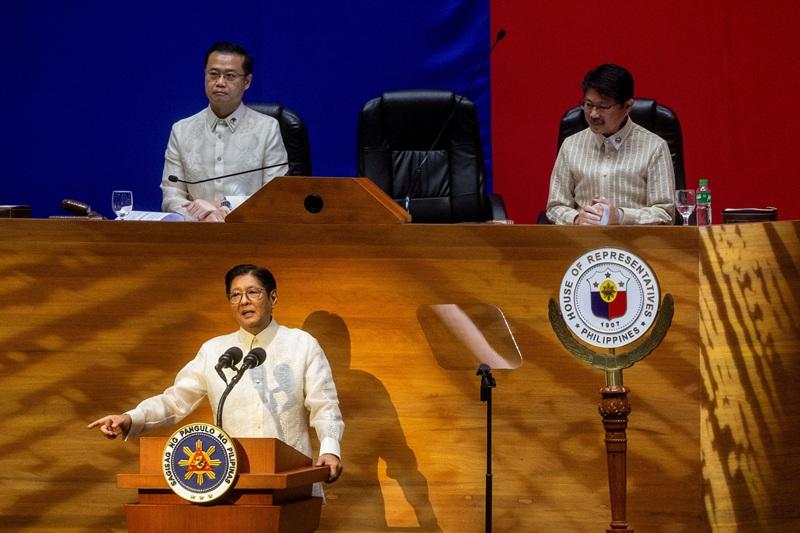
President Ferdinand "Bongbong" Marcos Jr. delivered his fifth State of the Nation Address (SONA) on Monday, touching on his administration's accomplishments, including what's been done with the flood control issue, which he first brought to light in SONA 2025, the measures his government has undertaken to ease the impacts of the oil crisis, a push to EV public transport, modern waste management practices, and nuclear energy production in support of the country's transition to clean energy and energy independence.
But climate advocates noted the President left out key issues including Super El Niño, which is already present in the tropical pacific.
"There is a Super El Niño coming to our country during the final months of 2026, which is usually the time of the year when strong typhoons also hit in recent years. Yet the closest to a plan to address this that the President said in his speech is the construction of more evacuation centers," JL Algo, the national coordinator of Aksyon Klima Pilipinas said in a statement.
In a recent media briefing organized by the Institute for Climate and Sustainable Cities, climate science adviser Lourdes Tibia said the country will feel the brunt of the Super El Niño beginning October.
"There will be a less number of cyclones in latter 2026 but they can be of typhoon or super typhoon category," she said. "Dry spells will likely start in November and if El Niño will persist up to 2027, the warm season of next year will be warmer," Tibia said.
Said Fr. Edwin Gariguez, the lead convenor of Protect VIP, "The SONA missed the opportunity to outline concrete actions on environmental protection. There were no significant announcements on addressing climate change or the upcoming super El Niño."
Waste Management, Energy Concerns
During SONA, Marcos made a push to amend the 25-year-old Ecological Solid Waste Management Act to align with modern waste management practices like waste-to-energy (WTE) and waste treatment technologies.
He also mentioned how it is time to revisit nuclear energy production to boost the country's power supply and bring down power rates.
But Algo said these aren't the answer, pointing to "the adverse impacts of WTE on the environment and communities, such as the situation in the Smokey Mountain area."
"The likes of waste-to-energy and nuclear power have taken center stage in BBM’s priorities, while renewables were basically deemphasized," he said.
According to the Asian Peoples' Movement on Debt and Development (APMDD), "pitching nuclear power as a quick fix for high power bills is a dangerous distraction that misleads the public. In reality, nuclear energy is too slow, vastly expensive, and inherently unsafe."
APMDD added that the Department of Energy's (DOE) draft tender rules for pioneer nuclear plants still"puts private profits ahead of consumer protection and renewable energy progress."
"While the administration pitches nuclear energy as a future solution, the proposed framework threatens to lock the country into exorbitant power rates, squeeze out cheaper renewables, and burden taxpayers with multi-billion-dollar liabilities for decades," APMDD said as it highlighted the "physical hazards of nuclear power" to a country like the Philippines, an archipelagic nation situated on the Pacific Ring of Fire.
"The Philippines is riddled with active fault lines and frequently battered by super typhoons. Siting reactors and storing volatile radioactive waste in regions prone to earthquakes and storm surges invites catastrophic risk. A single seismic event could trigger radiological contamination, devastate marine ecosystems, and destroy local livelihoods," it said.
In his speech, the President also called to amend the Electric Power Industry Reform Act (EPIRA) to put a stop to system loss charges, including an accompanying value-added tax (VAT), from being passed on to consumers.
It received the loudest applause but Greenpeace Philippines in a statement said the President "must go beyond lowering electricity prices and reforming EPIRA."
"Reviewing EPIRA is a good start, but it is not enough. Energy reform must go beyond this by accelerating a just transition to renewable energy, modernizing the grid, and removing barriers," Greenpeace Philippines campaigner Jefferson Chua said.
“Filipinos deserve lower electricity bills, and the President is right to recognize that. We welcome efforts to expand renewables because they put clean energy directly into the hands of Filipino communities. But these gains will be undermined if the government continues to pursue nuclear power, fossil gas, and waste-to-energy—costly and hazardous false solutions that deepen Filipinos’ exposure to volatile global markets, health hazards, and environmental degradation," he added.
"These false solutions, like fossil gas and burning waste, are just delaying our transition to renewable energy and placing millions of Filipinos firmly in the hands of foreign and corporate interests," Chua said, adding that the Philippines is already "rich in resources that can power our future."
"Investing in local solar, wind, and modern renewable infrastructure shields consumers from unpredictable global fuel prices, generates sustainable green jobs, and builds a truly resilient economy from the ground up," he said.
Transport
Meanwhile, the President made sure to mention the government's efforts to cushion the oil crisis as well as his push for public transportation to shift to EVs. But the conveners of the Mobility Awards noted the omission of active transport like cycling and walking in the SONA.
Referencing a recent Pulse Asia survey which revealed 94% of Filipinos supporting safer and wider bicycle lanes and walkways, Amber Garma, the national coordinator for the Mobility Awards said, "by ignoring active transport, the SONA has turned its back on the 94% carless majority."
“For millions of workers, walking and cycling are not lifestyle choices—they are financial lifelines that drive daily productivity. It is deeply frustrating that our highest leadership continues to neglect the safety and welfare of the carless majority, while funding and infrastructure remain heavily skewed toward the 6% who own private cars," she added.
Pax Silica
In his SONA speech, Marcos said that Pax Silica Industrial Hub will benefit Filipinos by providing quality jobs.
The AI-focused industrial complex spanning 1,600 hectares in New Clark City in Tarlac—“will create an eco-system that will have AI at its core. It will bring quality jobs to our people, accelerate our industrial competitiveness, and revitalize our economy.”
But according to Greenpeace, the vision "raises questions about how the country’s growing energy demand will be met, and whether Filipinos will ultimately end up bearing the burden of higher electricity prices."
"If Pax Silica becomes another justification for depending on false solutions, it will lock Filipinos into the same fossil fuel dependence and environmental harm that the President claims to be fighting. Filipinos should not be made to subsidize the energy demands of a foreign-led AI supply chain while they continue to struggle with expensive and unreliable electricity," Chua said.
— GMA News

