

 GMA Brandtalk
 Tracking
 Archives

Will 'Oppenheimer' bring home the Oscar?
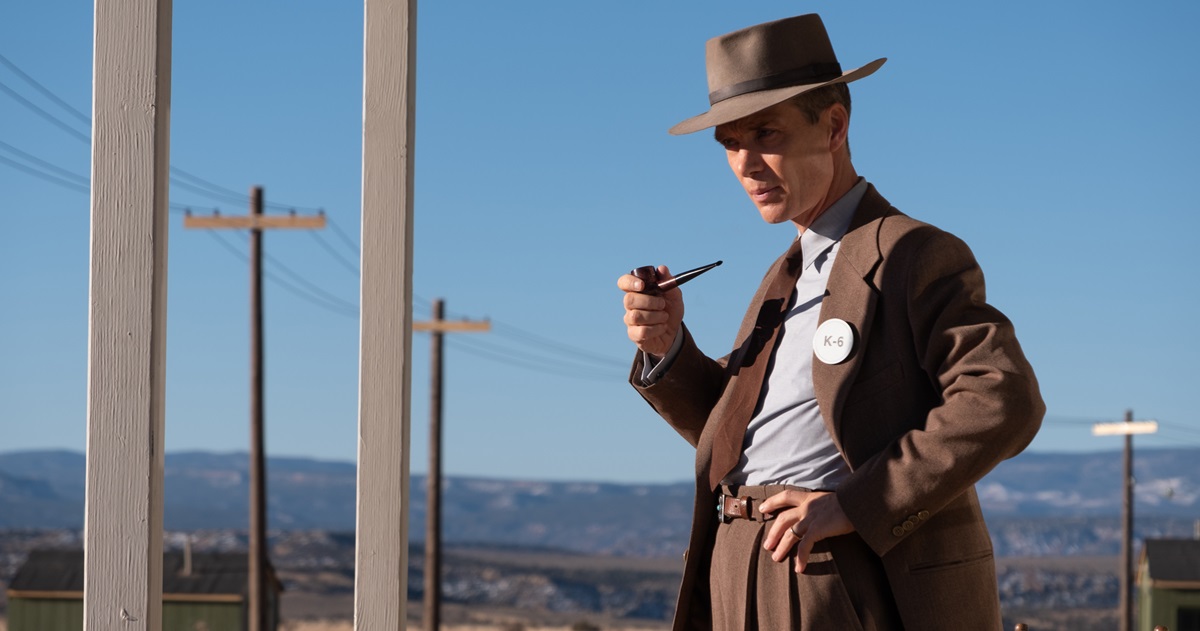
After bagging the Golden Globes, the BAFTA, the SAG and just tonight the Producers Guild of America top awards, Christopher Nolan's biographical thriller epic film "Oppenheimer" is now the obvious frontrunner to the Oscars.
Also strong contenders for the Best Actor category and Best Supporting Actor category are Cillian Murphy and Robert Downey, Jr. respectively. The two actors have been getting most of the award nods this season and it will not be a surprise anymore if they get the coveted Oscar statuette in these categories.
"Oppenheimer," which is written, directed and co-produced by Nolan, is the story of J. Robert Oppenheimer (portrayed by Murphy) the American physicist who is also known as the "father of the atomic bomb." The film also stars Robert Downey, Jr. as the United States Atomic Energy Commission member Lewis Strauss and Emily Blunt, as Oppenheimer's wife Kitty.
Other stars include Matt Damon, Florence Pugh, Josh Hartnett, Casey Affleck, Rami Malek and Kenneth Branagh.
Below are excerpts of the interview with Murphy, Downey and Blunt at the post-screening Q&A at the Linwood Dunn Theater at the Academy's Pickford Center for Motion Pictures.
Cillian, I know you've been back home doing things with the family. Have you had a moment to reflect on your time playing Oppenheimer? Because I know at the time it was just this breakneck pace and you were really trying to just be faithful to the script and I know that you're humble enough that you weren't thinking about much more than that. But have you had a chance to reflect on it and taken away something from your experience playing him and again the reception?
Cillian Murphy (CM): The reception has been extraordinary. It was bizarre. When we finished the premiere in London, we did the red carpet and then we went on strike. It was done very abruptly. Then the movie came out and it had this amazing response from audiences and so many people went to see it. We were all texting, kind of in shock. You know, lots of emojis.
It takes a while to process. For all of us, for Chris (Nolan), Emma (Nolan) for everyone involved in the movie, it takes a while and still, it's lovely now to come and talk to you guys and to be able to interact with audiences and to be able to process it a little bit, but I don't know I'm still figuring it out.
Have you all had the chance to have a communal experience and watch the film with an audience?
CM: I saw it in Paris.
Emily Blunt (EB): Yeah, I went to New York, and we managed to get the two last seats at the IMAX opening weekend. And we went to the 4 p.m. screening when I saw a group of teenagers coming in with pipes dangling out of their mouths, dressed as him (Murphy). I thought that was unbelievable. I got goosebumps. I texted Cillian afterwards, I was like, you're not going to believe what I saw. It was just so cool.
Robert Downey Jr. (RDJ): I didn't get a chance to see it, so I screened it in East Hampton for everyone.
EB: Same thing.
RDJ: This blows doors off New York. And I invited everyone that I thought was out there around this time of year and everybody RSVP'd and right before the movie started, I sat down, and Paul McCartney was sitting next to me, and I was watching the movie and also just listening to him breathe.
EB: Is he a heavy breather?
RDJ: No, but I was attuned to him because I thought this might never happen again. And it was incredible to see this. I mean, y'all know it just happened to have this communal experience, to see something that is so purely cinematic, just exquisite.

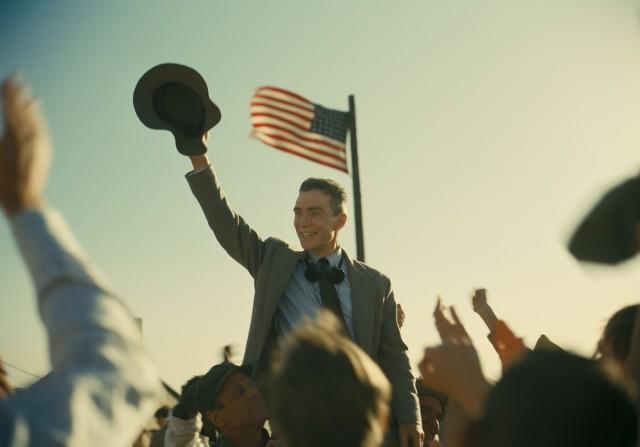
Cillian, I'd love for you to talk about one scene that I've spoken to Ludwig Goransson about, and that is the scene after they do the bomb and he's having that strange out-of-body experience where he's getting this adulation, it feels almost like a horror movie at that moment. And I, again, going back to it, I've now read the script, the stage direction at that moment was just so incredible because it was the conflict within the character. And I'd love for you to talk about, again, in a room full of performers, what you were accessing at that moment as an actor because it is such a delicate thing that you were trying to convey. And if folks read the script, they'll understand what I mean by that. And so how did you set up that part of the performance on that day and what were you trying to convey? Because he's not speaking, but he's saying so much.
CM: First of all, we shot that scene in Fuller Lodge in Los Alamos, in the real environment that those scientists would have been in and socialized in and hung out in, and remember we shot there, and Chris did that very deliberately. I'm not a superstitious guy but I do believe in the field of vibrations in a place where you feel the energy in a room, and you could feel there was something about the history of that room, so I remember it wasn't even a full day for that.
I remember we did that bit outside first and then we all did it. It was like half a day to do that scene and I don't think we talked very much about it, myself and Chris, because with those sorts of scenes all you need to do is just think about what happened what happened, and I was very aware that at that point it was like about the dilemma and the conflict and the contradiction and all of those things that he was trying to deal with.
So, we didn't, we just shot it quickly and the extras were fantastic that they were. They were not extras, there were a lot of actors, and they were giving in the scene and we just did it. Sometimes with those things, the themes are huge, and the dilemmas are so huge. You just have to think about it. You don't have to talk about it.
Robert, I wanted to talk to you about the opening scene and so that's why I wanted to bring yours first because now that I've gotten to see how brilliant that third page of that script is because it tells so much about Strauss, your character, and also Alden's character who doesn't even have a real name he's called the Senator's aide.
RDJ: I kept trying to give Alden a name and Chris said, "Not necessary." I was like the SAG rep. I was like I don't know what name I might have. I was like, I'm working on it with Chris. Steve, anyone? Not too late to change the credits.
But this is important though, because I wanted to say, his anonymity really adds to that scene. And because the thing I appreciated about it is, in that scene, there's one line that's repeated, and that you first give to him, and that he gives back to you right before he ushers you into your butt-kicking and that is who would want to defend an entire life? And I thought that was so careful because when you were saying it, you were saying it as a brush off and when he was saying it, he was saying it as a threat. I'd love for you to talk about how you were playing that scene because I think it's illustrative of the character. It shows how much he underestimates those around him.
RDJ: Yeah, and back to Chris, in the script it opens, and it says Fission and it intros our hero and it says Fusion and it intros Strauss and his point of view. I just remember that day when the Baton Memorial building in Santa Fe, and I think it was the first day I think it might have been the first thing we shot anyway, so I was in my body and just trying to establish something.
And I was realizing, as we all did, the way, what his rhythms are and the way he works, and it's so efficient that the only thing that could go wrong is you. And it was good, we know all that one. It's mortifying to start sometimes. And then, but like my missus always says, once the first clapper goes, half your problems go away, because the anticipation is gone and you're in it. But I'm glad you noticed that first scene because it is so critical, and great directors know that a character's introduction is the only thing you have to get right.
It is so pitch perfect.
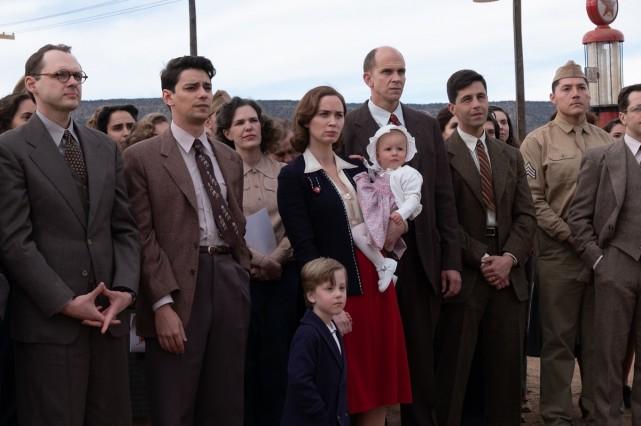
EB: It was a fantastic setup I realized because at that point she's so unpredictable, volatile, and dangerous potentially and has lost dignity in people's belief in her other than his and I love that they've walked through fire together and that he does believe in her.
I remember reading that in the script, that she's not quite walking in a straight line going in there. Amazing Jason Clarke, I just have to give props to like him, it's just the most ferocious, intimidating prosecutor. We loathe so much by the time she comes in that you just need someone to come in and rip the face off him. You're just desperate for someone to do it and no one's fighting for him.
Clearly, she's a character who doesn't care at all what anybody thinks of her, and I found her so lethal. I loved that scene because it's a reclamation of that brilliant brain that went to waste at the ironing board probably and you want to see her come back to life and fight for him convincingly because everyone else toed the line, so it was an amazing setup and fun to do it.
I think with this character, she's very interesting and with so many different layers and dynamics, but I think that it would be one of those things where you said a dinner party with the Oppenheimers would probably be painful.
EB: I actually remember the first time we did the camera test, and we did our prosthetic makeup, and we were laughing so much during the camera test and Chris would be like, "Alright guys if you just look at each other and then look right." I'd look at him and we'd go (deadpan stare) because we just looked horrifying the first time you see yourself because normally you go into the makeup chair and you're like, "I will look better by the time I leave this trailer." Sort of the opposite. What did Chris say? He goes, "Laughing is cheating."
You have got to keep them serious. But the thing I would say is, if there's any aspect of playing her that you found to be the most difficult or the most familiar with in her different platitudes. And I hate to say that as a comparison, because I know she's very difficult, but there are a lot of admirable qualities within the character as well.
EB: Yeah, I admired her and empathized with her. I think so many women at that time had to contort themselves into being something that was so out of character, out of nature.
She was a terrible mother and certainly didn't subscribe to good housekeeping, just not built for it, and driven mad in that isolation and loneliness of Los Alamos. I admired her. She's certainly a non-conformist, he's her fourth husband by the time she's 29.
Christopher Nolan definitely cast all of his actors because he sees something within them that they can access the character very easily. Like it's almost like everyone's coming, doing a part that is so familiar to them, they don't have to stretch that much. What do you think Cillian, as far as you playing Oppenheimer now, that maybe you've had to reflect upon it, that you found to be the most similar to maybe yourself, or the one that you found to be the most diametrically different?
CM: Yeah, oh God, it's one of those questions. Genuinely, I didn't feel that much connective tissue with the character. I don't think you need to have that. Me, personally, I don't think I need to have that. I don't think there has to be that exchange for me. And it was like, really, when I read it, and he sent it to me, it went, holy f------ sh-------.
I don't really know how to do this. I genuinely don't know how to do this. But we had a long time. Chris says in his very offhandish way, I was writing the script, and he had the book beside him and apparently there was some physical resemblance. So, there was that I guess. He's an astonishing, never to be seen again individual. A lot of his contemporaries would say that he was the most brilliant of them all, like beyond Einstein and all that. So, you're talking about a man that, like that brain that will never, it's one in a million.
CM: I think I found him intensely human. That's what people ask me about him, and I go he was intensely, relatively human.
Aside from all his genius and his flaws and his contradictions, he still was naive. He still believed after how it happened in 45 that there would be a world governance and that this genocidal weapon would be managed and that all nations would come together and would have common sense and that he could still be that brilliant to think that.
That's intensely human. So that I connected to. And the relationship, you never know what goes on in any relationship. But there was some beautiful interdependence or symbiosis that kept these two together forever and it's sustained and that scene you were just talking about I love that scene so much because it shows how much they cared for each other even though they probably never said it. I probably never articulated it so that was my way in that he was a human being. So, he wasn't the physics.
Robert, I loved how you said that Chris told you it was Mozart and Salieri. And the thing I love about that is I picture them the way Milos Forman put them in Amadeus. I'm not a student of history enough to go past the film. But one of the conceits of that one is that Salieri loved Mozart. And I'm wondering if there's a scene where you could maybe see that playing out with Strauss, or if you thought that was something that you kept from the performance.
RDJ: Well, this is a weird one, and tell me if it's like this for y'all, still, this contemplation, and when you get a role or a thing and you're into it, it doesn't end when you're done and it's out and you're talking about it or even years later, it's a lifelong kind of like talisman that you can keep going back to.
So, yesterday, I just Googled Salieri. And, when Mozart wrote Don Giovanni, Salieri put out an opera that was better reviewed. And history doesn't care about that because it's decided that it was black and white. So, I think also just like in Nolan and making that reference he was inviting us to see well there's the Milosh Forman version, the historical version, and now there's the revised history that we know more about the way we were talking correctly about what it was.
You can say the same thing about the Atomic Age, and you can say the same thing about when political preferences become too extreme. Strauss, particularly conservative, Oppenheimer possibly a bit too progressive, that it just doesn't serve the people because if they could have met in the middle of the aisle, then Atoms for Peace might have happened and perhaps Strauss would have said, "Hey, you're acknowledging me, what is it that you want to do? Okay, let me show you how to deal with the UN. I can help you."
So, I think that it is, as Nolan said, it was a bit of a horror movie. I think it's history and it's also a tragedy. And it's something that we can do better. Just because they're geniuses and special, we hold them as the greatest generation, whatever. We're the greatest generation now. It's our job to try to do things a little better.
I don't think you told me about whether or not you think that he loved them on the inside though.
RDJ: It was animus because it was always this thing about... I think the bookends between the heart of the movie are these implied insults or slights and how petty everyone can be. What's not petty is what happens there. That's love, that's beautiful. The rest of the stuff is you know.
So, there's that one, there's the time when the isotopes, you give me crap about that, and then the final straw is when you blow off my daughter at my birthday party. Because you're bummed out that things didn't go your way. See, I'm almost feeling like Strauss. Because this is what we do, right?
We take on the mantle of, I have to be in the point of view of that person fully. And I have to fully be in their shoes, even if I'm nothing like them. And that's the great gift we get, we get to this forced perspective that is not our own. Which is, why Cillian, every day said, "I just really don't know what I'm doing." And then he would go do something so hard, so well. So, our host was saying, I don't have to know to do this well. I just have to be in these shoes.
EB: I think this is one of the most sublime performances I've ever seen. I think it's utterly riveting. I think all of his wonderful mercurial qualities lent themselves to this ambiguity that you get kidnapped by this character not just because of his ocean eyes but because of his extraordinary abilities that are kind of meteoric.
I was so lucky, this is the second time I've worked with him, and he is my favorite scene partner. Fact. It's true. And it was just a joy. It was a joy. We could jetpack in and out and get lots of breaks in between and I can't believe the burden and the monumental task of what he had to take on for this. He held all of us together every day and I remember Downey saying to Chris Nolan, "You're so lucky to have someone like him that comes in every day and is as kind and warm as he is but as prepared and is sublime, it's so unusual to have that."
RDJ: And then the theater, and it's all so small, and you're doing it for the love of the game, and you do it for the 240, whatever the minimum is, and you're lucky if there's an equity cost.
Nolan is so Spartan, and then you're the focus of this Spartan important thing. But to me, the biggest sacrifice is we know all those things and actors usually love to talk about everything they had to do with their diet and their regimen and how they slept in a coffin, and you know what I'm saying.
But what I saw was the struggle within you every day to permit yourself to play someone so completely different from you in that you're very engaging and very conscious and very polite and very thoughtful. And this guy is in his own world.
So, I think the first time you just have to let your scene partners know, 'hey, it's not that I don't like you and I don't care about you. Clearly, it's the character I'm doing.' And then you wouldn't overcompensate, but it was almost like, in every frame of this, you had to go to a place that is not your nature because it was the nature of what you were trying to portray.
And I think that, to me, that was the real hat trick, because it's lonely, dude. It's lonely to have done that on top of everything else. And I think that's the weird thing. You're number one on the call sheet, you're in every frame, and in a way you're in this free solo type of weirdo place. I saw you manage and survive it and that's why you're quite good at this.
CM: The reason why I think the film works is because it's got the best f------ actors in the world.
These two guys in particular, you know, because I had so much stuff with these two guys. The work, you could see it, you just saw it. It's just astonishing what they did. It's imprinted on your psyche, these two characters in this movie. The skill, the dexterity, and the nuance they give to these characters. But that's a given. We all have known about these actors for years and years, they're just legends.
But for me, it was also just the kindness and empathy and the humanity that they showed me during the shooting of the thing. Because it was tough. I mean, it was fast, it was furious, and it was tough.
But it was just this huge empathy and kindness. And being in scenes with these guys, and I think you all know this when you're making a scene, it's never about the actors, it's about making the best scene possible. Doing the most truthful, most honest work you can do.
And that's what you get from actors of this caliber. And I felt held and secure and safe working with these guys through it. Not just on set but off set and that's a gift.
—MGP, GMA Integrated News

