

 GMA Brandtalk
 Tracking
 Archives


Financial institutions tapped to offer affordable residential solar loans
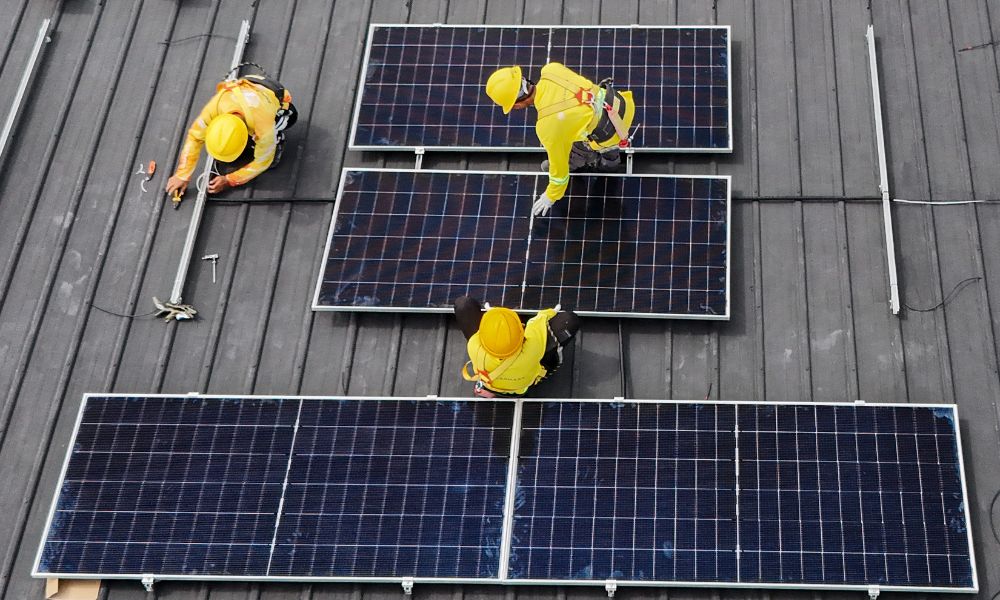
The government has mobilized financial institutions to offer affordable financing options for installation of residential solar panels amid push for cleaner energy, said Executive Secretary Ralph Recto.
“Focus will be on families who cannot afford the high upfront cost of shifting to solar energy," he said during a meeting with various state loan and financial institutions last November 26.
“These are low-risk loans that will yield a high ROI, and the savings can pay for the installation cost," Recto added.
The meeting was attended by officials from the Government Service Insurance System (GSIS), Social Security System (SSS), Pag-IBIG Fund, Land Bank of the Philippines, and Development Bank of the Philippines (DBP).
“Savings on electricity bill will result in additional purchasing power. Dahil bawat pisong matitipid sa singil sa kuryente ay dagdag sa pambili ng pagkain, sa baon ng mga anak, at sa pang-araw-araw na gastusin ng pamilya," the executive secretary said.
(Every peso saved on electricity bills means more money for food, the children's allowance, and the family's everyday expenses.)
In his fifth State of the Nation Address, President Ferdinand Marcos Jr. called for expanded renewable energy adoption and make rooftop solar and battery storage more affordable and accessible to Filipino households.
Under its Ginhawa Solar Energy Loan, GSIS currently extends up to ₱500,000 to qualified borrowers at a 5% annual interest rate over a five-year payment period.
Meanwhile, the Pag-IBIG Fund provides up to ₱300,000 via its home improvement loan, featuring a promotional 3% annual interest rate and repayment terms of up to 10 years.
Residential solar setups can also be financed through Pag-IBIG’s Housing Loan Program, which offers loans of up to ₱10 million.
The SSS is currently finalizing its proposed Energy Sustainability Loan, whereas LANDBANK aims to launch its SunPower Loan—tailored specifically for home solar systems—in the first quarter of 2027.
Beyond residential setups, LANDBANK also funds rooftop solar initiatives for enterprises, cooperatives, local government units, and other qualified organizations, covering up to 80% of project expenses for private entities and up to 100% for eligible government borrowers.
Similarly, the Development Bank of the Philippines funds up to 100% of project costs for qualified public institutions and up to 80% for private organizations under its Energy Efficiency Savings Financing Program, with infrastructure projects eligible for up to 10-year repayment terms.
In August, the DOE issued a circular simplifies the rules governing Self-Generating Facility Zero-Export Solar Systems (SGF ZESS) and Micro-Solar Systems (MSS), allowing consumers to generate electricity for their own use without exporting excess power to the distribution grid.—RF, GMA News

