

 GMA Brandtalk
 Tracking
 Archives

ADVERTISEMENT
Filtered By: Lifestyle
Lifestyle
Book review: ‘The School for Good and Evil: A World Without Princes’ blasts fairytale tropes with wit and wonder
The classic fairytale’s enduring charm has ensured its immortality in the countless reinventions of beloved stories such as Snow White and Sleeping Beauty. But it is rare for such re-imaginings to be infused with as much wit, humor, and pure, childlike wonder as 2013’s “The School for Good and Evil.”
This bestselling fantasy for children took familiar fairytale tropes and turned them upside down. Author Soman Chainani achieved this by dumping a generic, Disney-esque princess in with the villains, and a brooding witchy type with the heroes. Only the “heroes” and “villains” themselves weren’t clear-cut good and evil, giving the author plenty of room to probe the true nature of both, and the much-overlooked gray areas in between.
This year’s “The School for Good and Evil: A World Without Princes,” a sequel to that novel, revisits Chainani’s rich, colorful world while presenting us with another seeming dichotomy just ripe for exploration. The result is a funny, frenetically paced adventure chockful of lessons to be learned, though one that goes down a markedly darker path than its predecessor.
When Happily Ever After is not enough
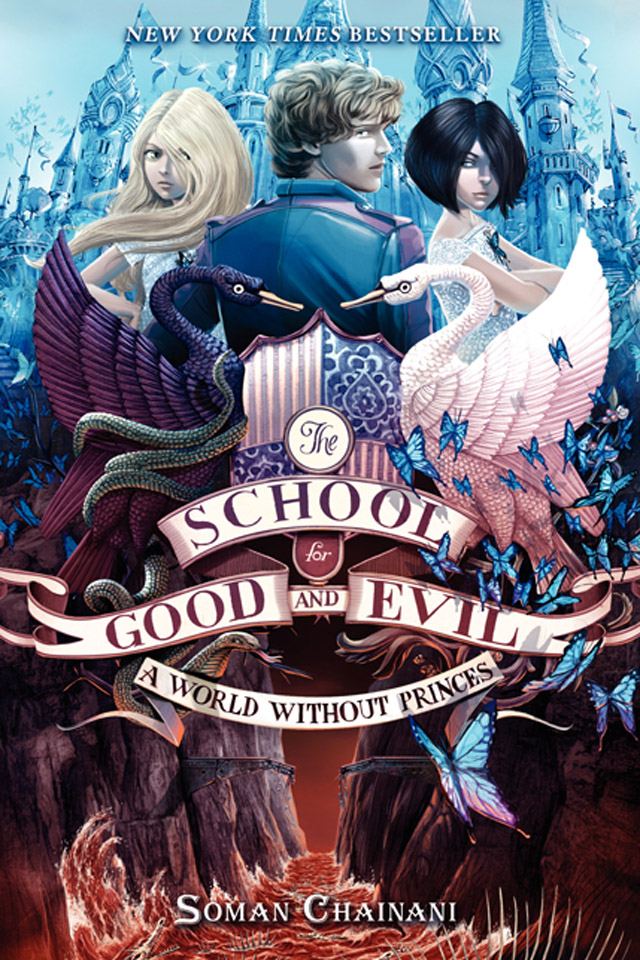
The cover of "The School for Good and Evil: A World Without Princes." Cover from Harper Collins Publishers
In “A World Without Princes,” goth girl Agatha and her beautiful, self-centered best friend, Sophie, have returned to their quaint village of Gavaldon to live out their Ever After. Only, their happy ending isn’t all it’s cracked up to be, at least for Agatha. Something is missing for her—something she had left behind in the conclusion of their previous adventure.
And so she makes a secret wish—for a different ending to their tale.
This results in the fabric separating Gavaldon from the magical realm to rip open once more, and after a cascade of harrowing events, the pair find themselves back in the School for Good and Evil. Only, things have drastically changed.
Old rivalries have been dissolved, with alliances now forming between previously bitter rivals. For if the original schools once locked Good and Evil souls together in eternal competition, the renovated schools now pit Girls against Boys. And this time, each side is gearing up for bloodshed.
In a race to save both factions from outright war, Sophie and Agatha will brave new perils, and even come face to face with a new villain. But the real enemy—the one that will threaten to tear the best friends apart once more and forever—is the residing within.
Unlikely heroines
Now aware that all decisions have consequences, the best friends have matured since their first adventure, becoming more reflective than reactive. This is most readily seen in Sophie, and the frequent, often painful clash between her selfish side, and the side determined to prove she is a Good person. For if the first book was primarily about Agatha, this second installment is more of Sophie’s story.
One of the complaints lodged against “The School for Good and Evil” was the flatness of Sophie’s character relative to Agatha’s. The novel opens with Sophie’s narcissistic inclinations back in full swing, but while the previous book only showed us her shallower aspects, “A World Without Princes” reveals the genuine heartaches that serve as the impetus for many of her thoughts and actions. Thanks to this, Sophie becomes a more sympathetic character, and even a tragic one.
As for the self-effacing yet resourceful Agatha, she too spends a huge chunk of the tale examining that facet of her life she mostly neglected in Chainani’s first offering. Both main protagonists have plenty of emotions to work with, and issues between them begging for resolution. The ups and downs of their friendship, and the angst that is borne of its fragility, is what drives the story forward, seamlessly intertwining character development and plot in a way that is satisfying and ultimately heartbreaking.
Of princes and witches
Perhaps the one thing that brought the first book down was the forced romance involving a certain callow boy prince. While Tedros remains as immature as ever in “A World Without Princes,” his personal history is also passed under a magnifying glass, helping to make him, if not more likeable, then at least redeemable.
Many supporting characters also make a comeback, including an intriguing trio of witches: the demon-tattooed Hester; Anadil with her squad of pet rats; and Dot, who has relinquished her unhealthy compulsion to devour every chocolate in sight for a healthier obsession with veggies.
There aren’t many new characters, but a sultry professor for the School for Girls and the vicious Aric of the School for the Boys do make lasting impressions and nice additions to the roster.
Subverting stereotypes
While the original novel challenged preconceived notions of good and evil, “A World Without Princes” tackles a topic its predecessor actually already touched on—gender inequality.
Chainani investigates the blurred lines between the two genders, but turns satirical when dealing with extreme stereotypes of masculinity and femininity. The worst of the boys are illustrated as little less than hairless apes, while the virulent hatred of all things male that some mistake for feminism also rears its ugly head. Throughout the book, however, the author never overtly voices his own opinions, or endorses a particular way of life. Instead, he acknowledges the differences between the two sexes, while also recognizing that which unites them—subtly discussing human strengths and frailties without veering into heavy-handed moralizing.
Familiar magic
Chainani has the same gift as J.K. Rowling: the ability to keep your nose stuck in a book for several hours straight. This is thanks in part to his choice of language, which is simple and never ostentatious. The pace also hurtles forward at fantastic speeds, hardly pausing for breath; whether a character is in the middle of a mission or experiencing a personal transformation, there is never a lull in the narrative. There is always a hook to pull you forward, and sometimes the suspense is so unbearable you’ll be tempted to jump paragraphs just to know what will happen next.
Though the outcome is a book jam-packed with content, no detail, no matter how seemingly insignificant, is ever wasted; something subtly inserted into an earlier chapter will be of extreme importance hundreds of pages later.
The story is incredible in its unpredictability, with more twists and turns you can shake a bespectacled boy wizard’s wand at. Thankfully, none of these twists sacrifice plot integrity or character growth for the sake of shock, so you’ll never feel like the writer has betrayed you.
Action scenes are breathlessly exciting, leaping out of pages with a ferocity rivaling the most thrilling parts of “Hunger Games.” Chainani is also a master of creating an atmosphere of hopelessness and dread, with the darker moments truly capturing Agatha and Sophie’s desperate plight. The stakes are exceedingly high, and failure is a monster at the door, only too eager to barge in and destroy everything they hold dear.
As the middle of a trilogy, however, “A World Without Princes” does fall prey to the cliffhanger ending that asks more questions than it resolves. Let’s just hope this becomes a springboard for an outstanding finale, rather than one that leads to a whimpering end.
Once upon a time…
“A School for Good and Evil: A World Without Princes” is a novel bursting with energy, imagination, and fun. It upends the status quo of the timeless fairytale, injecting enough contemporary concerns into the narrative to make it not only a great read, but a relevant one.
Agatha and Sophie make wonderful leads—intelligent yet reckless, at times loveable, at times insufferable, but always relatable, with flaws, needs, and struggles immediately recognizable in ourselves. Through them we are reminded that life is a road paved with difficult choices, and sometimes, in our attempt to find happiness, we end up breaking someone’s heart.
For whether in the real world or a fantasy realm, life will always be an adventure, a journey through the daunting, yet often beautiful valley between Good and Evil. — VC, GMA News

