

 GMA Brandtalk
 Tracking
 Archives

ADVERTISEMENT
Filtered By: Lifestyle
Lifestyle
Book review: The quicksilver mind in Cesar Ruiz Aquino’s ‘Caesuras’
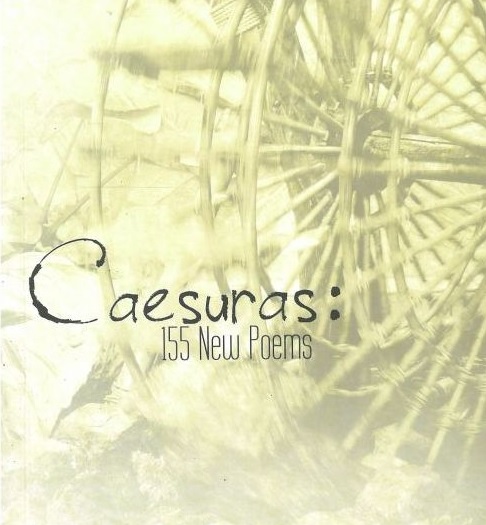
Cesar Ruiz Aquino reincarnates as the puckish wordsmith in "Caesuras: 155 New Poems" (UST Publishing, 2013).
Consider, for instance, “My One-Line Taglish Epic,” nearly reminiscent of Jose Garcia Villa’s sparse, if mind-altering, modernist poetry. This poem contains a single line, “Ini-epic kita”, an obvious play on “Iniibig kita”. It is also an appropriation of the word “epic” which has in recent times has become part of pop culture slang, connoting a superlative experience (as in, “I had an epic hangover!”).
Aquino’s works are also filled with risqué humor and double entendres. In one of his haikus, “Seeing Double”, he writes:
Shall I compare you
to her? She is more lovely
you, more beautiful.
And there is “Le Ronde,” which is suggestive of a ménage-a-quatre:
I’m looking at you
looking at him looking at
her looking at me.
In “The Love Son of J. Alien Ginsbeer,” he gives a flippant allusion to the treacherous, and perhaps cowardly, pro-American character that we know of the first president of the Philippine Republic, while the title apparently hints to Beat Generation icon Allen Ginsberg:
I saw the best men of my general
(General Emilio Aguinaldo)
go under and in short I was afraid.
This ludic poet is not foreign to cross-breed stylizations, as we see in his “Thirteen-Line Sonnet, One-Man Rengga”:
No one can be that beautiful and not love
All
In your conception of all.
In “Sad Ending,” a 12-line conversation between a girl and boy, the poem ends with the girl’s final punch line to put an end to the slippery relationship: Girl: Love is what you never felt.
The Cebuano-speaking poet also employed words from his mother tongue, as in his use of the Visayan word "garay" (rhyme or verse) in “Haiku in English w/ Cebuano in it.” Some of the poems also refer to Aquino’s sojourn to Thailand as a SEAWrite awardee, his memories of his hometown Zamboanga, and his recollections of the lush and picturesque Dumaguete where he is now based. In an interview, the Silliman University creative writing professor said that he is presently busy writing an “anti-novel.” He also shared that while he is not exactly propelled by any poetic vision in this collection, the Palanca-winning poet succinctly declares what every creative writer would always insist on: “write I must”.
The collection is punctuated by a final six-line poem called “Imaginary Renga” which Aquino culled from the verses of five poets, among them Ted Hughes, Seamus Heaney and Filipino poet Wilfredo Pascua Sanchez. An exercise in meta-poetic fabrication, it is a testament to Aquino’s “quicksilver mind ever in motion,” as his fellow Dumaguete-honed poet Marjorie Evasco would describe him. The invented renga’s first stanza goes:
You revelled in red
Through my own country, adept
At the sight of you.
We might as well expect that our roguish mage of letters, in his delicate balance of whimsicality and rigor, will continue to concoct heaps of rich servings to delight readers, and fill us some more with “a sonnet to sadness/ pudding stanzas, macaroni enjambments/ salad lines & all.” — BM, GMA News
Rina Angela Corpus is an assistant professor at the Department of Art Studies, University of the Philippines. Her research interests include feminist aesthetics, dance history and spirituality in the arts. Her poetry has been featured in various publications.

