

 GMA Brandtalk
 Tracking
 Archives

Art is the answer
“Art is the answer!” my friend Patricia Araneta instagrammed while strolling through Art Fair Philippines 2017. She’s an art historian who ranges black art in America, indigenous art in Africa, Asia and Austronesia, glorious 12th century Islamic art in Baghdad, Morocco and Eurasia, and the Hindu and Buddhist icons all over the Indian subcontinent up the Himalayas from foothills to peak.
Having stood before timeless icons of art and faith in situ all over the globe, I imagined her smiling widely in her own native Manila when she next instagrammed a long line of mostly young people waiting to enter the Link, that 7-storey car park turned overnight into a tongue-in-cheek art venue in Ayala Makati.
Art Fair Philippines had 6,000 visitors on its first year in 2013; that nearly quadrupled to 22,000 in 2016. 2017 was nearly double that at 40,000. Lead organizer Trickie Lopa says the Link reached full capacity on Saturday and Sunday afternoon. They had to limit entrance “to allow visitors a chance to view the pieces properly.” Visitors were allowed to enter only in batches “as the crowds inside thinned.”
There was so much to see! With 11 special exhibits on three floors (the fourth, the roof deck reserved for five well-chosen art lectures and a chi-chi art cafe), eight public art installations, booths for 46 exhibitors with hundreds of Filipino artists and four Asians, Manila had the look of a new global nexus for the arts.
Profitable, too. No official reports of sales figures were available at this writing, but Trickie says she discovered from “casual conversations with our participants” that most of their pieces were sold. “Several galleries even changed their exhibits in the course of the fair; the new pieces brought in were sold as well.”
Good for keeping artists’ body and soul together. Good for art. Good for Filipino consciousness. Good for investors as the peso does another loop-d-loop with the U.S. dollar. But most important was: “If art is the answer, what’s the question?”
Question and answer hung in the air as I opened my senses wide for the full impact of what was before me on my own private stroll, avoiding beso-beso encounters in super-sosyal Manila.
It seemed that all of Manila’s well-heeled millennials, the modern mestizaje, were flocking in...posing, contorting, making faces for selfies with “art.” Distracting though were, they had the perfect right. What were these art objects, after all, but one long wail of a creative people in turbulent times?
Patricia next PM’ed on Facebook, “Young, creative, energetic, so upbeat!” True. There was so much variety of form, technique, subject, art history that this fair needed at least a full week of daily attendance to do justice to it all. Early on I admitted that it was impossible to do more than focus on what struck me most.
Ronald Ventura’s brightly plumaged birds disappearing with other endangered wildlife were the first images to hit home—shadows vanishing into forests now mere memories in islands once known as one of the world’s richest, also most threatened, niches of biodiversity.
Enter Elmer Borlongan, Emmanuel Garibay and Mark Justiniani of the Zambales art collective sailing on Tagadagat (Of the Sea)—a wall-to-wall mural of a long boat strikingly helmed on either end by a man and a woman facing opposite directions. Dead center sits a giant head with two (perhaps more) pairs of eyes; to its left and right are disparate types of Filipinos—a half-naked savage, a prayerful manang with her eskapularyo, a dark-suited hacendero wearing shades as he harvests the fat of the land with a scythe borrowed from Death itself. Above the boat float tiny emblems of our culture of centuries—the Golden Tara of Butuan, a pair of Ifugao bulols, the ornate entrance of Intramuros.
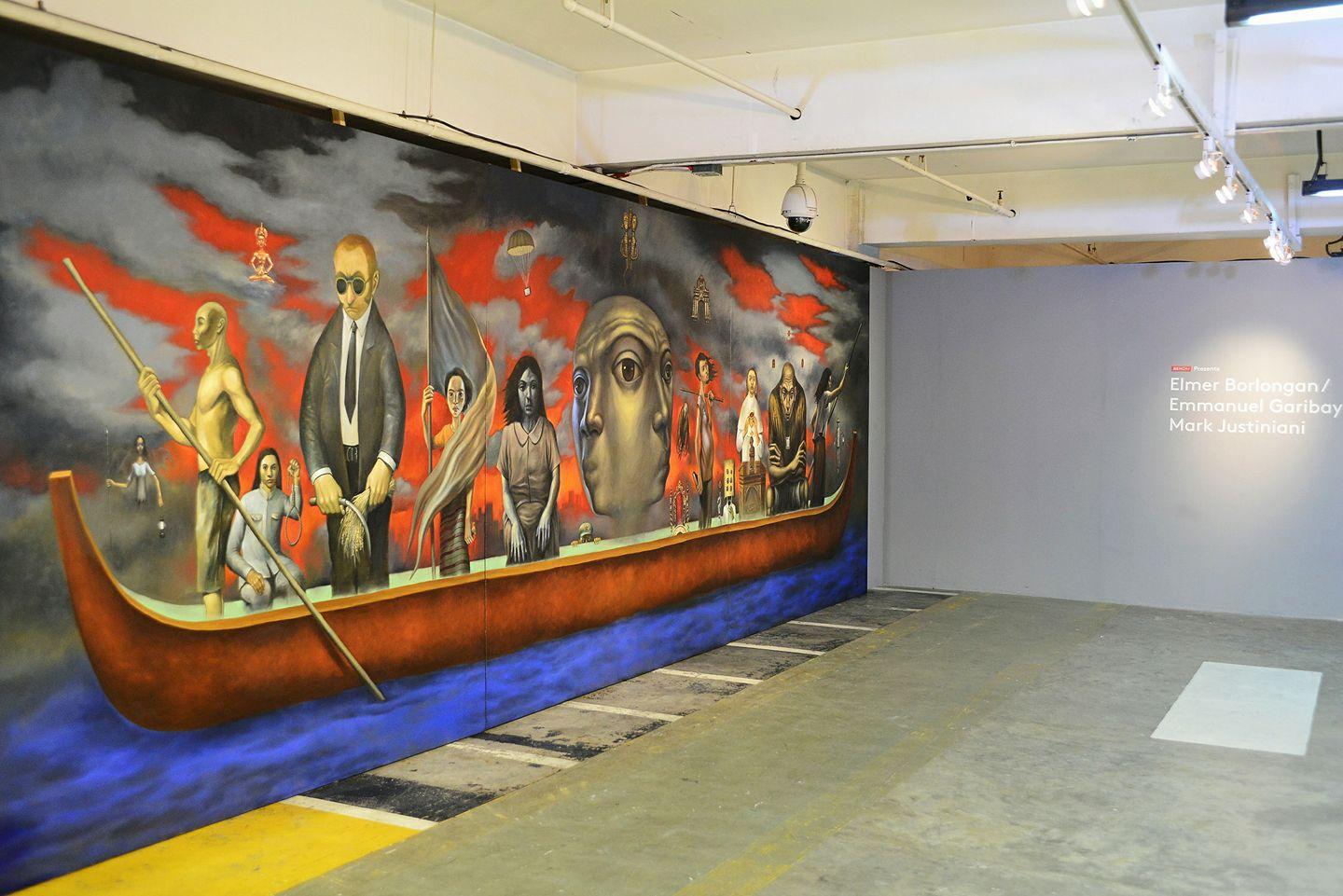
The mural’s text intones: “We are in search of the Narrative, the story we can tell on who we are. As individuals. As people. As nation. The problem is not a dearth of stories, rather the overwhelming noise of disparate visions competing for attention and commitment. Everyone, it seems, now wields a narrative—the weapon of choice in the ongoing clash of ideas. Why, how can we proceed into the uncertain future?”
In artful exhibit flow, Jose “Bogie” Tence-Ruiz was next, reinforcing the silent impact of Tagadagat with his Langue Lounge. His French-English wordplay means “Lounge of the Tongue” but it took a while to locate the giant tongue at the center of this startling installation. Colegialas were posing over and around it; a young couple was cuddling in one of the red velvet-lined electric chairs surrounding Bogie’s outrageous “cult of the tongue.”
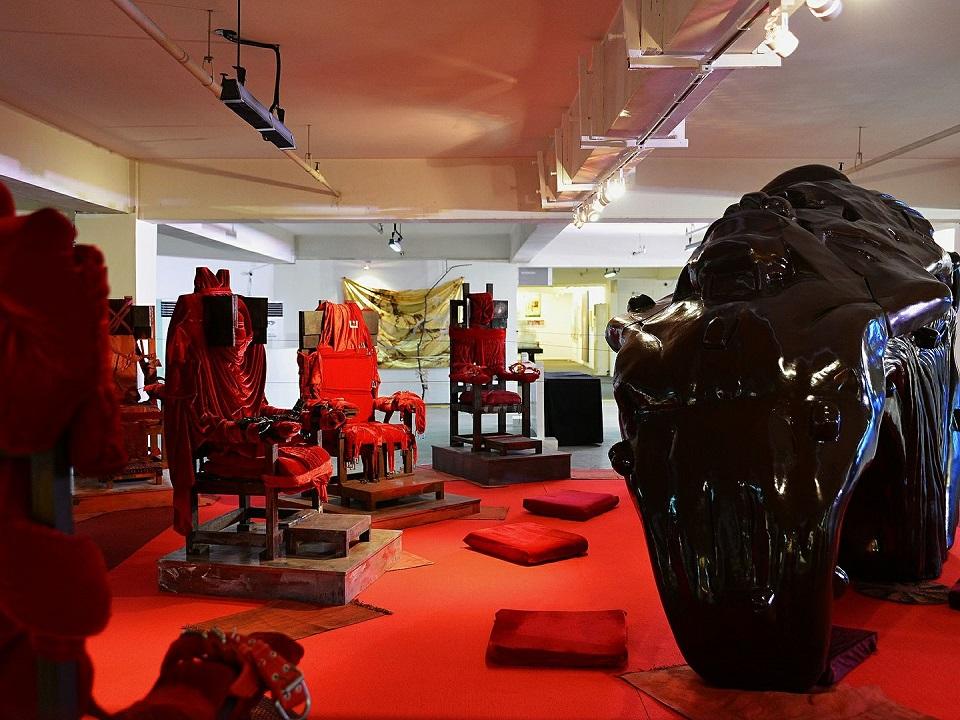
His text notes: “Admiration for rhetoric and parlance that paint the idea of a strongman as pleasantry (whose) rationalization is grounded in the power of charisma, no matter history, the mental and physical scars that linger. The persuasive orator always wins over the discreet innovator—through the viscera from the viscera.
“We are called upon to discern and maintain a ‘determined despair’—a realistic yet hopeful acknowledgment paired with a deep sense of action. The only difference between cowards and heroes is to keep courage one second longer.”
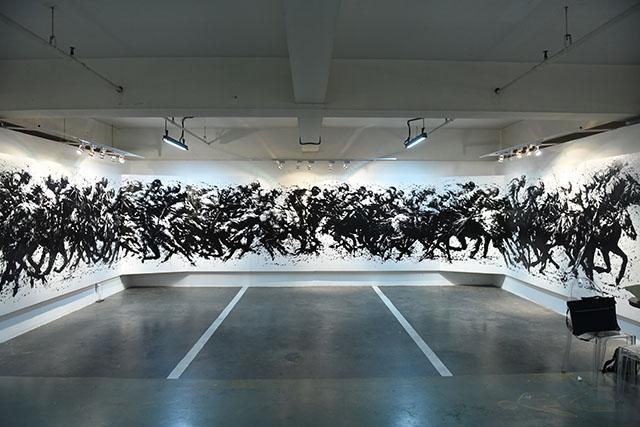
This is precisely what art is meant to do, thought I: “Keep courage one second longer.” Hard to do when powerful images surround you—youthful eroticism in and around the paintings, Adam rising to the stature of the gods, a solitary bubble of life exploding from a stark grey background, a black and white mural named “...go!” with racehorses tangled in a single fluid burst of speed at the Bang! of the starting gun. This was Filipino soul on the move!
But how rewarding it was to withdraw from overflowing outer dynamism into Agnes A. Arellano’s perfect stillness. Floating on the exquisitely lit black walls of her cosmic shrine were four starry sisters of the Constellation Pleiades—the goddesses Inana, Kali, Magdalene and Dakini, the latest standing sculptures of her unique Project Pleiades with more to come.
Agnes’s goddesses, starting with the moon goddess Haliya of yore, are all symbols of the Eternal Feminine directly at antipodes to the violent brutishness the world finds itself in today. Theirs is the nourishment of selfless love but theirs, too, is the power to heal as well as destroy in the constant renewal of Life in the magnificent cycles of Creation. To those who understood beyond the flash and sparkle of an art fair all around, it was a powerful moment of regaining balance, serenely renewing vision beyond a blood-soaked world. — BM, GMA News

